Functions of Protective Films: Types, Hardness Grades & Adhesive Selection for OEM Buyers
A functional protective film is an external layer applied to a surface to change how that surface behaves: how it reflects light, how it resists scratches and fingerprints, how it survives downstream processing, and how cleanly it can be removed afterwards. The main functional types on the market today are AR anti-reflective films, AG frosted anti-glare films, mirror films, privacy films, TPE/rubber hybrid films, liquid protective films and HD anti-scratch films.
On the supply side, the phrase protective film has quietly become a synonym for the phone screen protector. That shorthand hides how wide the category really is. By end use, protective films cover plastic products, digital products, automotive parts, household applications and even food preservation. The same gap shows up in B2B sourcing work: a film specified to survive the stamping of a stainless steel panel and a film specified for a consumer phone screen share almost nothing except the name.
Engineers and buyers tend to hit the same four problems. Film types look nearly identical on a datasheet. Hardness grades such as 2H, 4H and 5H are quoted without test data behind them. The wrong adhesive system produces bubbles, poor air exhausting or residue on removal. And regional supply differences stay invisible until a shipment is already on the water. This guide works through the category in the order a real selection decision happens: film type first, then hardness, then adhesive, then supply chain.
Who this guide is for
Product engineers, NPI teams and sourcing leads who need to shortlist a film type, read a hardness claim critically, pick an adhesive system that matches the substrate, and compare suppliers across regions. No consumer retail angle, no spec-sheet marketing: only the selection criteria that decide whether a film passes qualification. More selection guides like this are collected in our Technical Knowledge Base.
Not Just a Screen Protector: Where Protective Films Are Actually Used
The fastest way to mis-specify a protective film is to treat the whole category as one product. In practice it splits into two very different buying jobs.
Consumer electronics side
Films sold as finished screen protectors or applied to 3C device displays. Selection is driven by optical quality: transmittance, reflection control, fingerprint behaviour and how the film feels in the hand. Products are judged in the hand of the end user, often within seconds of application.
Industrial processing side
Films applied to components and semi-finished goods: stainless steel and aluminium plates, stamped and formed metal parts, tools, copper products and irregularly shaped workpieces. Selection is driven by process survival: tolerance, conformability, clean removal and yield after peeling. Typical homes for these films are industrial touch components and metal-processing lines.
Categorised by use, protective films span plastic products, digital products, automotive applications, household applications and food preservation. The materials themselves have also moved on: the industry has evolved from early PP films to the AR materials that dominate the higher-performance end today, an iteration that has taken well over five years. For a buyer, the practical consequence is simple: the film that works on a glossy phone screen will rarely be the right answer for a brushed aluminium housing, and the datasheet wording alone will not tell you which one you are looking at.
Seven Functional Film Types and the Problem Each One Solves
Each film type exists because it removes one specific failure mode. The table below summarises the seven types; the sections after it explain what each one is, how it is built, and where it earns its place in a BOM.
| Film type | Core function | Typical fit |
|---|---|---|
| AR anti-reflective | Cuts reflection and radiation, filters UV, keeps the image clear | Bright-light and outdoor displays |
| AG frosted anti-glare | Diffuses glare, resists fingerprints, wipes clean | Industrial HMIs, kiosks, bright indoor use |
| Mirror film | Mirror when the backlight is off, normal display when it is on | Devices with a mirror off-state |
| Privacy film | Restricts the viewing angle, protects on-screen data | Business and personal data protection |
| TPE / rubber hybrid | Elastic, tough, waterproof, removable protection | Industrial surfaces needing clean removal |
| Liquid protective film | Spray-applied coating for complex shapes | Irregular metal, aluminium, copper, tools |
| HD anti-scratch | Hard, transparent surface that resists stylus wear | Stylus-driven touch screens |
AR anti-reflective film
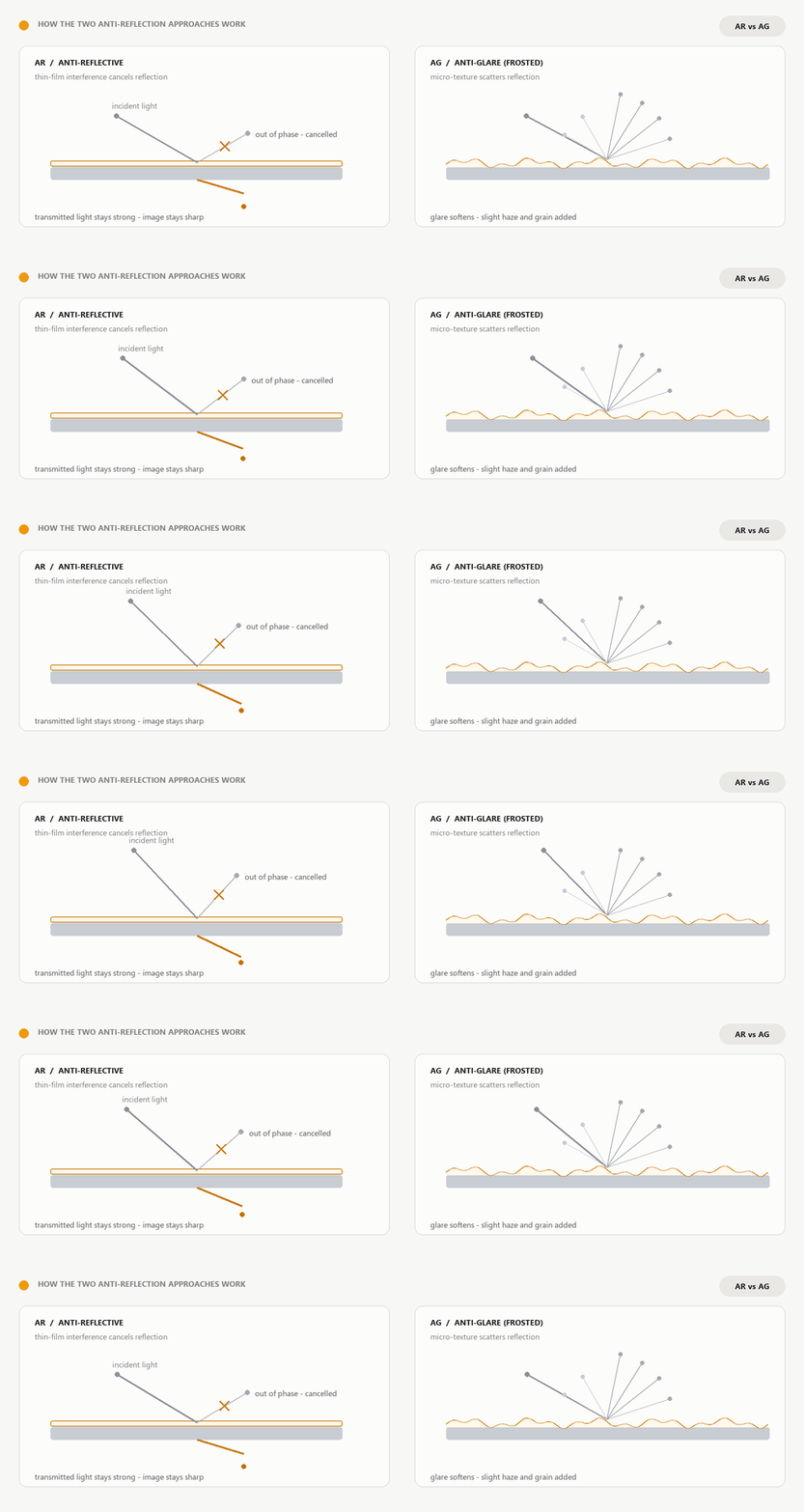
AR film is generally made of PET with a three-layer anti-scratch and anti-radiation structure, at a thickness of approximately 0.25 mm. It filters UV rays and combines anti-reflective with anti-radiation behaviour. Two properties matter most for a buyer. First, light transmittance reaches up to 99%, so the display stays clear and vivid instead of dimming behind the film. Second, it uses electrostatic adsorption rather than glue, which means it can be reapplied multiple times.
Solves: reflections and screen glare in bright environments without giving up image clarity. Watch out for: market quality varies considerably between suppliers, and wear resistance and scratch resistance differ accordingly; the GLAUKE brand is a well-known example in this category. Best fit: devices operated outdoors or under strong ambient light where readability, not texture, is the constraint.
AG frosted anti-glare film
AG film uses a three-layer structure with a frosted surface layer. The texture resists fingerprints and leaves no marks when the surface is swiped; sweat and other residues wipe away easily, which keeps the visual effect consistent over time. The material is processed with a special treatment that prevents glare and reduces reflections under sunlight or bright artificial light.
Solves: mirror-like reflections on glossy surfaces and the fingerprint build-up that comes with frequent touch use. Best fit: industrial HMIs and membrane switch panels, kiosks and any interface that is touched constantly and read under showroom or factory lighting.
Mirror film
Mirror film originated in Japan and is built from five to six layers, one of which undergoes aluminium vacuum evaporation so that the layer reflects external light and produces the mirror effect. The behaviour is two-state: with the main screen backlight off, the surface acts as a mirror; with the backlight on, text and images display normally through the film.
Solves: the requirement that a surface must be a mirror when the device is idle and a display when it is active, without switching hardware. Best fit: products where the switched-off panel is expected to do double duty as a reflective surface.
Privacy film
Privacy film uses micro-louver optical technology to limit the screen's readability to roughly a 60-degree viewing angle from the front. Content blurs at around 30 degrees off-axis and becomes unreadable beyond about 60 degrees. Modern privacy films frequently combine several functions in one construction: anti-reflective, anti-UV, mirror and anti-radiation behaviour.
Solves: on-screen exposure of business secrets and personal data in open offices, transport and public spaces. Best fit: corporate fleets, financial and healthcare devices, and any display that handles confidential content in shared environments.
TPE / rubber hybrid film
This film combines TPE plastic with rubber and inherits the advantages of both. It offers high elasticity, high strength and high toughness, is non-toxic and environmentally friendly, and is scratch-resistant, waterproof and easy to remove.
Solves: temporary protection that has to come off cleanly after processing, storage or transport. Best fit: industrial component protection where the film must survive handling and then peel away without damaging the finish underneath, and programmes where non-toxic, environmentally friendly materials are a requirement rather than a preference.
Liquid protective film
Liquid protective film represents the latest trend in the international protective film industry. It reduces material usage, saves resources and minimises waste. It can be applied using various methods and forms a protective film quickly upon spraying, adhering tightly to the surface. Its decisive advantage is geometry: it reaches places a pre-cut film cannot.
Solves: protection of irregularly shaped workpieces where conformable sheet film lifts, bridges or traps air. Best fit: irregularly shaped metal objects, aluminium parts, copper products and tools.
HD anti-scratch film
HD anti-scratch film is built as PET low-tack protective film on the surface, a release film as the base, and a protective layer. The surface is processed with SMART technology for superior wear and scratch resistance. The three-layer PET hard film prevents screen wear caused by stylus touch, and the high-transparency materials are matched to mobile screen properties so that light refraction and reflection stay consistent, delivering 100% transmittance.
Solves: abrasion from repeated stylus contact on a touch surface. Best fit: stylus-operated devices and custom touch interfaces and any touch application where optical clarity and surface hardness have to coexist.
Scratch Resistance Ratings: What 2H, 4H and 5H Actually Mean
Protective films are divided into three pencil-hardness grades. 2H is the regular grade and is not wear-resistant. 4H offers high resistance, and 5H is the carbon-crystal grade with super wear resistance. The step from 4H to 5H is not a different coating family: both rely on an ultra-thin crystal coating inside the protective layer, with 5H pushing the same approach further.
| Grade | Wear behaviour | Where it is typically found |
|---|---|---|
| 2H | Regular grade, not wear-resistant | Factory-supplied films — the ones that ship on a device to protect it in the box rather than to survive a service life |
| 4H | High scratch resistance, achieved with an ultra-thin crystal coating inside the protective layer | High-end branded protectors built on 4H structures (Glauke, OK8, BENKS class) |
| 5H | Carbon-crystal grade, super wear resistance — the same crystal-coating approach pushed further | Continuous-abrasion and stylus-contact applications that demand the top of the range |
The market structure around these grades is worth knowing before you compare quotations: high-end brands such as Glauke, OK8 and BENKS build their products on 4H and 5H structures, while 2H remains the grade most commonly found on factory-supplied films.
Do not buy a hardness number, buy a test result
A hardness figure on a datasheet is a claim about a coating, not a measurement of your part. The same nominal grade can behave differently once it sits on your substrate, goes through your lamination process and meets your cleaning chemicals. Before committing, run a pencil-scratch test on real samples under the conditions your product will actually see, and record the result as part of your qualification file.
Silicone or Rubber Adhesive? Matching the Adhesive System to the Substrate
The adhesive layer decides three things a buyer cares about: whether the film laminates bubble-free, whether it survives the customer's process, and whether it comes off without residue. The two dominant systems are not interchangeable.
| Silicone adhesive | Rubber adhesive | |
|---|---|---|
| Source | Developed from acrylic glues specifically to meet the demand of 3C products | Primarily produced in Europe and Japan |
| Defining advantage | Excellent air-exhausting behaviour, which prevents bubbles during application | High tolerance — a single viscosity applies to surfaces ranging from smooth to rough, a wider range than acrylic glues |
| Typical fit | PET-based screen protectors, 3C displays, the aftermarket | Complex post-processing such as stamping stainless steel and aluminium plates |
Silicone adhesives were developed from acrylic glues specifically to meet the demand of 3C products. Their defining advantage is excellent air-exhausting behaviour, which prevents bubbles during application. That property is why they are widely favoured in the aftermarket, and they are commonly used for PET-based screen protectors.
Rubber adhesives are primarily produced in Europe and Japan and are known for high tolerance. A single viscosity can apply to surfaces ranging from smooth to rough, which gives them a wider application range than acrylic glues. They are particularly suitable for complex post-processing such as stamping stainless steel and aluminium plates, where the film has to stay in place through forming, cutting and handling.
The selection rule that follows from this is straightforward. For 3C screens and any application where visible bubbles are a defect, silicone is the system to specify. For stamped metal, plate processing and rough or variable substrates, rubber is the system that holds up.
Global Supply Chain: Who Produces What, and Where
Protective film production was initially concentrated in developed regions such as Japan, the United States and Europe, and the division of labour between them is still visible today.
| Region | Strength in protective film production |
|---|---|
| Europe | Leads in rubber-based adhesive films; still dominant for stainless steel and aluminium processing |
| Japan | Leads in non-toxic PVC, PET and AR materials |
| United States | Among the earliest production regions, together with Europe and Japan |
| Mainland China | Developed rapidly; high-end output now rivals South Korean products. Production concentrated in Guangdong — particularly Shenzhen, Foshan and Dongguan — together with Zhejiang, Shanghai and Jiangsu |
Demand has followed the device market: the rise of touchscreens and 3G, 4G and 5G phones continues to drive demand for high-end protective films. On the material side, the route has moved from early PP films to the AR materials that define the current generation. For a worked example of how these films end up inside a finished interface, see our membrane switch design and sourcing guide.
Located within one of China’s core protective‑film manufacturing hubs, our facility leverages well‑established local supply‑chain resources. We offer custom development & sampling across multiple film types including AR, AG frosted, privacy, TPE/rubber hybrid and liquid protective films. Custom options cover 4H‑5H hard‑coat grades and both silicone and rubber‑based adhesive systems, catering to 3C electronics and industrial metal‑processing OEM projects.
Key Takeaways: A Selection Checklist for Your Next Project
- Start from the failure mode, not the film name. Reflection and UV are AR territory. Glare, fingerprints and constant touch point to AG frosted. Confidential screens need micro-louver privacy film. Stylus abrasion calls for HD anti-scratch. Irregular metal geometry is the case for a liquid film.
- Read hardness grades as claims, then verify them. 2H is the regular grade common on factory-supplied films; 4H and 5H achieve their resistance through an ultra-thin crystal coating. Benchmark against Glauke, OK8 and BENKS class constructions, but qualify with your own pencil-scratch test on your own substrate.
- Match the adhesive to the substrate and the process. Silicone for 3C screens and bubble-free lamination. Rubber for stamped stainless steel and aluminium, and for surfaces that vary from smooth to rough.
- Test samples on your own part before you release a PO. Apply, process, store and peel on real production material. Bubbles, residue and lifting only show up on your geometry, not on a supplier's sample card.
- Compare suppliers by regional strength. Europe for rubber-based adhesive systems and metal processing, Japan for non-toxic PVC, PET and AR materials, and the Guangdong, Zhejiang, Shanghai and Jiangsu belts for high-end volume production close to the electronics supply chain.
- If you require real‑world sample validation for your upcoming OEM project, we provide custom protective‑film samples tailored to your substrate, hardness grade and adhesive requirements. Reach out to our engineering team to start the sampling conversation.
Frequently Asked Questions
What is the difference between AR and AG protective film?
AR film is a PET-based three-layer anti-scratch and anti-radiation structure, about 0.25 mm thick, that filters UV and reaches light transmittance of up to 99% while using electrostatic adsorption so it can be reapplied without glue. AG film is a three-layer structure with a frosted surface layer that resists fingerprints, leaves no marks when swiped and reduces reflections under sunlight or bright light. In short: AR keeps the image as clear as possible by suppressing reflection; AG trades a matte surface for glare suppression and fingerprint resistance.
Should I specify 4H or 5H for my application?
Both 4H and 5H use an ultra-thin crystal coating inside the protective layer; 4H delivers high scratch resistance and 5H is the carbon-crystal grade with super wear resistance. Choose 4H as the standard target for branded, durable protectors, and 5H where abrasion and stylus contact are continuous. Either way, validate the grade with a scratch test on your own sample rather than relying on the label, because 2H films are still common on factory-supplied units and can distort a side-by-side comparison.
When is a liquid protective film the better choice?
Whenever the part is not flat. Liquid protective film is applied by spraying using various methods and forms a protective film quickly on contact, adhering tightly to the surface. It is particularly suitable for irregularly shaped metal objects, aluminium parts, copper products and tools, and it also reduces material usage, saves resources and minimises waste compared with cut sheet film.
Which adhesive should I use on stainless steel or aluminium?
Rubber adhesives. They are primarily produced in Europe and Japan, offer high tolerance, and a single viscosity covers surfaces from smooth to rough, a wider range than acrylic glues. They are particularly suitable for complex post-processing such as stamping stainless steel and aluminium plates. Silicone adhesives remain the better choice for PET-based screen protectors and 3C applications where bubble-free air exhausting is the priority.
Can I get custom protective film samples for my product qualification test?
Yes. We support custom sampling for protective‑film qualification. Our scope includes different film constructions, pencil‑hardness grades (2H/4H/5H), and adhesive types for both consumer electronics and industrial component applications. Reach out to our engineering team to share your project specifications.