What Is a Membrane Switch? Structure, Types & How It Works
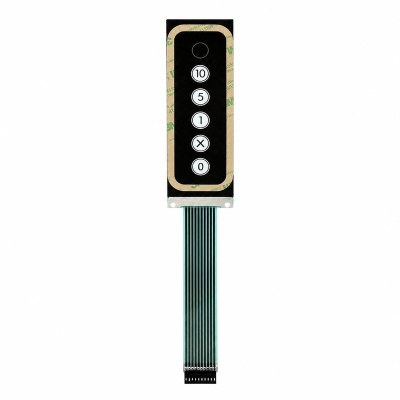
A membrane switch is a thin, flat, printed switch assembly that closes a circuit when a finger presses the graphic overlay — no moving button, no metal mechanism and no gap for dust or liquid to get in.
You already use them: the keypad on a microwave, a blood glucose meter, the front panel of a CNC machine. This guide stays on three questions only — what the panel is made of, which build to specify, and exactly what happens inside when a key is pressed.
Numbers to keep in mind as you read: a standard membrane switch panel finishes at 0.8 – 2.0 mm total thickness and uses 4 to 8 functional layers. Actuation life runs from 1 million to 10 million presses, sealing is IP65 and above, backlighting is done with LED plus light guide film, and the actuation force sits at 1.5 – 3 N typical.
How Does a Membrane Switch Work?
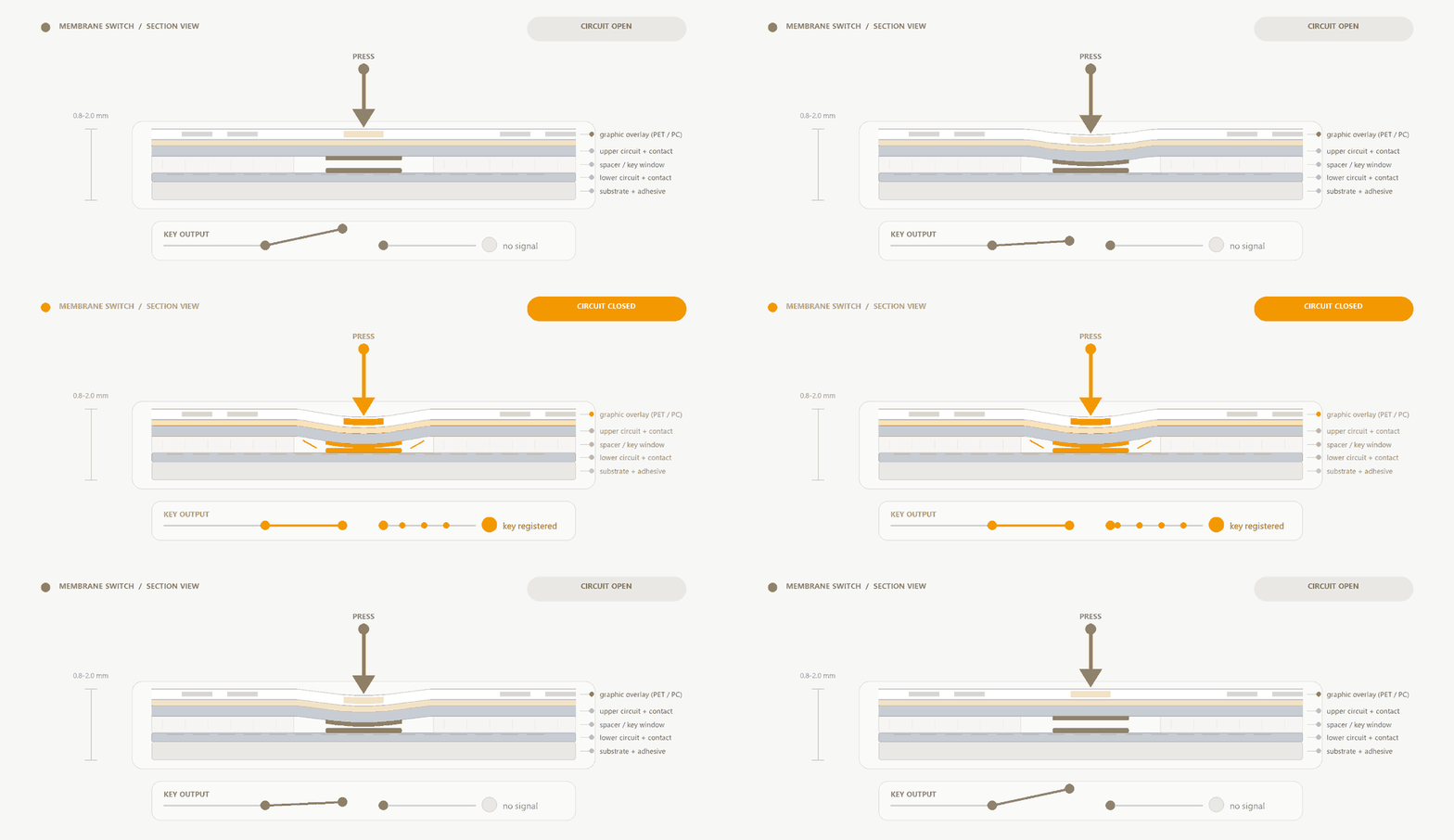
A membrane switch is a normally open contact pair. Two printed circuit layers are separated by a spacer film, and a window is cut in that spacer underneath every key position. At rest the circuit is open. Press the overlay and the upper circuit layer flexes down through the spacer window until its contact pad touches the pad below.
That contact closure is the entire switch. There is no spring, pivot or sliding metal part to wear out, which is why a panel rated for millions of presses still adds only about a millimetre to a product face.
The switching cycle in four steps
- The finger presses the graphic overlay at a printed key position.
- The overlay and the upper circuit layer deflect downward.
- The upper contact passes through the spacer window and meets the lower contact, closing the circuit.
- The controller scans the closed key, runs the function, and the film returns to its open position.
On a panel with many keys the circuit is laid out as a row-and-column matrix, so a controller can scan 24 keys with only a handful of I/O pins. Add a metal dome under the key and the dome snaps over centre when pressed — that snap is the tactile feedback, and it also produces the audible click that tells an operator the key has registered.
Membrane Switch Structure: The Layer Stack
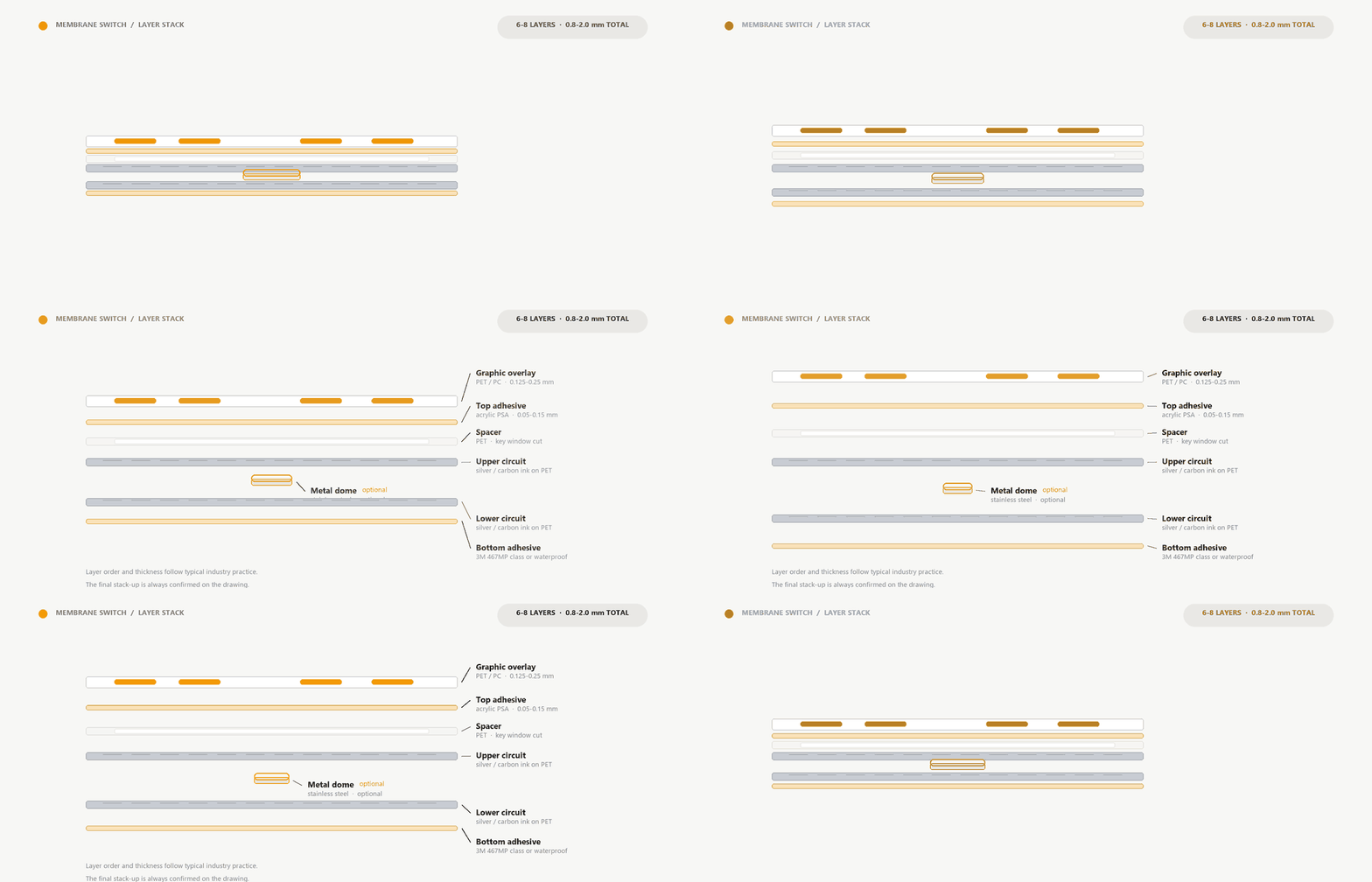
A membrane switch panel is a laminated stack, not an assembly of parts. A standard tactile design uses six functional layers and finishes at roughly 0.8 mm to 2.0 mm total. Layer order and thickness below follow common industry practice — the final stack-up is always confirmed on the drawing for your project.
| Layer | What it does | Typical material and thickness |
|---|---|---|
| Graphic overlay | Carries the printed graphics, key legends, windows and branding, and protects the panel surface | PET or PC film, 0.125–0.25 mm, with hard coat |
| Top adhesive | Bonds the overlay to the spacer and seals the key area | Acrylic pressure-sensitive adhesive film, 0.05–0.15 mm |
| Spacer | Holds the two circuit layers apart and defines the key window and the air gap | PET with double-sided adhesive, gap 0.10–0.25 mm |
| Circuit layers (upper and lower) | Printed conductive traces and the mating contact pads that make the switch | Silver or carbon ink on 0.125 mm PET |
| Metal dome (optional) | Adds a crisp tactile snap, audible feedback and a defined actuation force | Stainless steel dome, taped to the circuit or held in a retainer |
| Bottom adhesive | Mounts the finished stack to the enclosure or housing | 3M 467MP / 468MP class PSA, or a waterproof grade |
Graphic Overlay: Where the Material Decision Starts
The overlay is the only layer the user sees and touches, so it sets both appearance and durability. PET is the usual choice for industrial and medical panels: good chemical resistance, stable dimensions, clean printing and a lower cost point. PC takes impact better and can be cold formed into embossed or curved shapes, but it is more sensitive to certain solvents. The overlay is normally reverse printed on the second surface, so the ink sits behind the film and cannot be scratched off in use.
Circuit Layer: Silver Ink, Carbon Ink or Etched Copper
Silver paste gives the lowest initial resistance and is the standard for most keypads. Carbon ink has slightly higher resistance but better long-term stability on long, dense traces and in humid environments. Etched copper on polyimide is used when trace density, current carrying capacity or flex fatigue goes beyond what printed ink can deliver.
Metal Domes and the Other Optional Layers
The metal dome is the most common optional layer. Its diameter, height and force rating decide how the key feels and how firmly it must be pressed. Other options include LED indicator windows, light guide films for even backlighting, and ESD shielding.
Types of Membrane Switches
Three constructions cover the large majority of projects. The choice comes down to how the key should feel, how many keys there are, and how the panel connects to the control board.
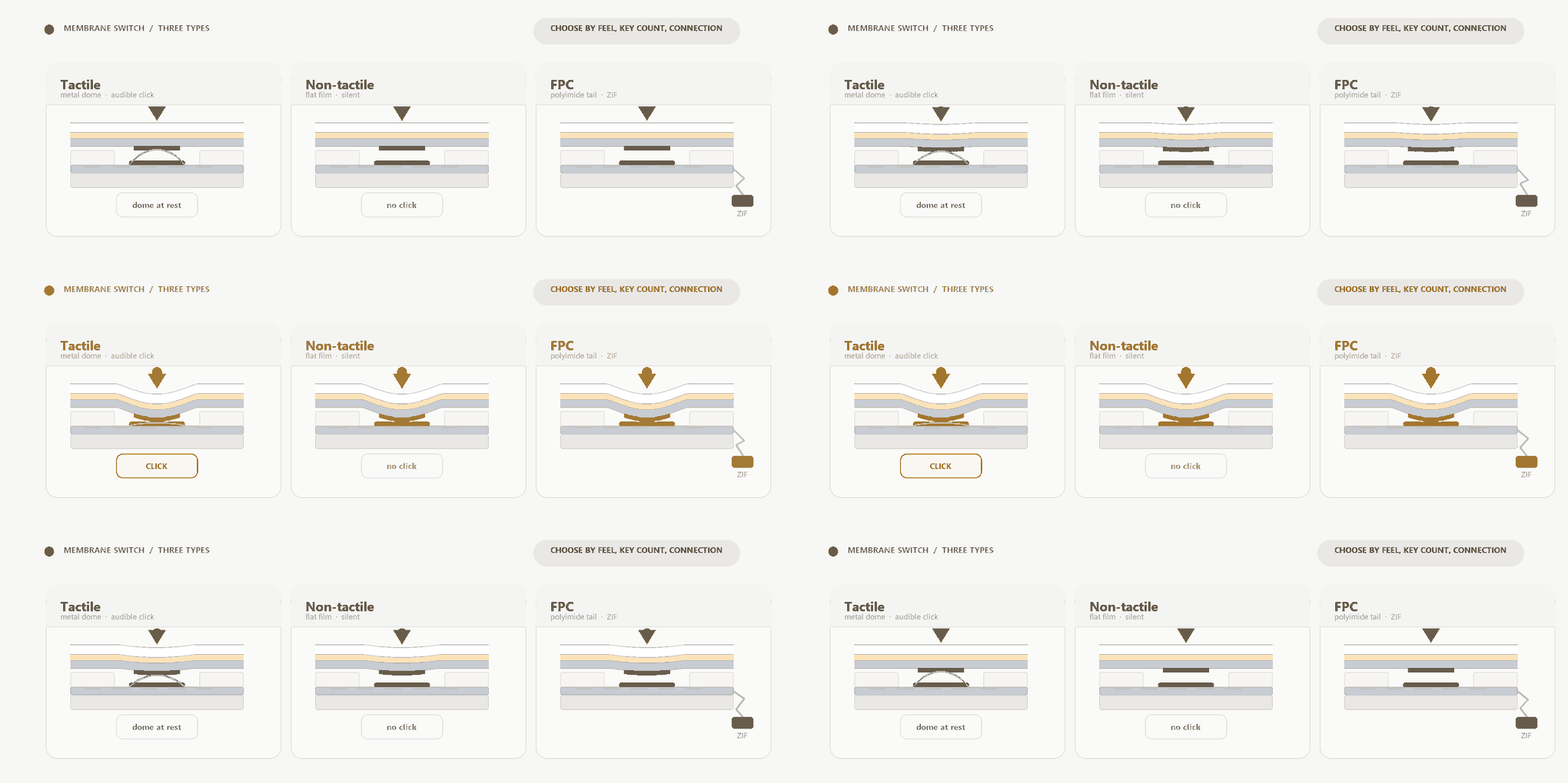
Tactile membrane switch
Choose it when the operator works by feel
A metal dome under each key gives a crisp snap and an audible click, and defines the actuation force. This is the default for equipment used with gloves or in noisy plants, and for any interface where an accidental key press is expensive.
Non-tactile membrane switch
Choose it when the surface must stay perfectly flat
No dome. It is the thinnest and the quietest option, with the key detected by contact closure alone. It suits sealed front panels that get wiped clean, slim handheld devices, and interfaces where a display provides the feedback. A polydome — a formed bubble in the overlay — sits in between: softer, and completely silent.
FPC membrane switch
Choose it when the tail has to reach a crowded board
The circuit is built on polyimide, or the PET circuit is extended into a flexible tail that plugs straight into a ZIF connector on the main board. That removes a separate connector and hand soldering, keeps routing tidy inside tight enclosures, and becomes the standard route once pin count or trace density grows.
Membrane Switch vs Mechanical Switch
The two are rarely interchangeable, and the deciding factors are thickness, sealing and how the product is assembled rather than switching performance alone.
| Factor | Membrane switch | Mechanical switch |
|---|---|---|
| Construction | One laminated printed film stack, graphics included | Separate actuator, housing, cap and wiring per button |
| Panel thickness | Typically 0.8–2.0 mm | Often 10 mm or more including the switch body |
| Actuation force | Set by the dome, commonly 1.5–3 N | Typically 2–5 N with longer travel |
| Sealing | Sealed by lamination, IP65 and above achievable | Needs a boot or gasket around each switch |
| Service life | Commonly 1–10 million actuations | Typically 100,000 to 1 million actuations |
| Design change | Reprint the overlay and re-cut the layers | New caps, legends or tooling |
| Best fit | Flat, sealed, graphic-rich control surfaces | Isolated high-force or high-current actions |
Where a membrane switch is the wrong answer, it is usually because the application needs very high current switching or a single large, heavily actuated emergency control — in that case a discrete mechanical switch is the correct choice.
FAQs About Membrane Switches
What is the difference between a membrane switch and a membrane keypad?
They are the same product. Membrane switch is the engineering name for the switching element and the layers around it; membrane keypad is the everyday name for the finished panel a user types on. Buyers also say membrane switch panel or face plate. When you compare quotations, the drawing and layer stack-up matter far more than the label.
Are membrane switches waterproof?
The layers are bonded together with adhesive, so there is no open path from the surface to the contacts. With a hard coated overlay, a closed-cell adhesive and a properly sealed tail exit, IP65 is routine and IP67 or IP68 designs are possible. Water resistance should always be specified as a rating, because the adhesive grade and the cable exit usually decide the final result.
How long do membrane switches last?
Service life is quoted in actuations and is driven mainly by the dome and the circuit ink: a standard metal dome tactile switch is rated for one to ten million actuations, which exceeds the working life of most instruments. Excessive actuation force, sharp tools, strong solvents on an unprotected overlay and sharp bending of the tail are what shorten it.
Can membrane switches be backlit?
Yes. Light from surface mount LEDs on the PCB is spread by a light guide film behind the overlay, or diffuser layers are printed so that only the intended legends glow. Because the LEDs sit outside the switch stack, backlighting does not change the tactile feel, and it lets a panel show status without extra openings in the enclosure.
The short version
A membrane switch is a printed, laminated interface: two circuit layers separated by a spacer, protected by a graphic overlay, and mounted with a rear adhesive. It is chosen when a product needs a thin, sealed, graphic-rich control surface that survives millions of presses without maintenance. Getting it right is a stack-up question rather than a print question — overlay material, ink type, spacer gap, dome force and adhesive grade together decide how the panel feels and how long it lasts.
Where to Start When You Specify One
Two answers decide most of the stack-up: what the operator needs to feel, and what the panel has to survive. Before you compare quotations, ask each supplier how the stack-up is confirmed on the drawing, whether the actuation force is sampled during production, and how the tail is sealed at the exit point.
Dongguan Zhongjia Printing has built membrane switches and printed panels for 17 years in a 20,000 m² factory, with cleanroom printing, die-cutting and assembly in-house under IATF 16949 and ISO 9001 systems. Send the drawing or a marked-up sketch through our membrane switch customization page or contact us directly, and we will return a proposed stack-up, a unit price at your quantity and a lead time.