
Home / All / Case Study / The “Invisible Killer” of Membrane Switch Reliability: Why Adhesive Dome Holders Cause Key Failure—and How to Eliminate the Problem
The “Invisible Killer” of Membrane Switch Reliability: Why Adhesive Dome Holders Cause Key Failure—and How to Eliminate the Problem
The “Invisible Killer” of Membrane Switch Reliability: Why Adhesive Dome Holders Cause Key Failure—and How to Eliminate the Problem

1. The Invisible Killer of Membrane Switch Reliability
In the field of human-machine interface (HMI) components, few failure modes are more frustrating—and more quietly destructive—than a "dead key." Even one failed key on an industrial control panel, medical device, or consumer appliance can trigger warranty claims, production-line downtime, and in some cases safety incidents.
Recently, one of our long-term OEM partners encountered exactly this problem. During incoming quality control (IQC), a sample batch from another supplier showed a serious failure mode in a significant proportion of keys: after being pressed, the keys could not return and remained collapsed. In engineering terms, this is a "dead key."
The customer's questions were straightforward: What caused the problem, and how could it be solved permanently? After systematic failure analysis, the root cause pointed to one component: the adhesive on the Dome Holder (metal-dome retaining layer). This article breaks down the physical mechanism, explains the design risks of adhesive Dome Holders, and demonstrates why an adhesive-free design is necessary.
2. How a Metal-Dome Switch Works: A Quick Review
To understand how a dead key occurs, we first need to review the layer structure of a tactile metal-dome switch. A typical four-layer membrane switch stack includes:
• Graphic Overlay — the top layer touched by the user, with printed legends and transparent windows.
• Metal Dome — a stainless-steel dome, commonly four-leg, triangular, or round, providing tactile feedback and electrical conduction.
• Dome Spacer — a PET spacer layer that locates and isolates each dome through die-cut cavities. It normally includes vent channels that allow air to flow out during pressing and back in during return.
• Dome Holder / Retainer — a thin PET film that holds each dome above the circuit contact and prevents lateral movement during pressing.
• FPC / PCB — the bottom circuit layer with gold-plated or carbon-printed contacts.
When the user presses the overlay, the force is transferred to the metal dome. The dome buckles downward and contacts the circuit pad, closing the switch. When the finger is lifted, the elastic energy stored in the dome returns it instantly to its original shape, opening the contact and producing the characteristic click. This return action depends on two conditions: the elasticity of the dome itself and—critically—the ability of air to flow back into the cavity beneath the dome without obstruction.
3. Root-Cause Analysis: Tracing the Dead Key to Adhesive on the Dome Holder
3.1 Failure mechanism, step by step
After disassembling and analyzing the failed samples, our engineering team identified the following complete chain of failure:
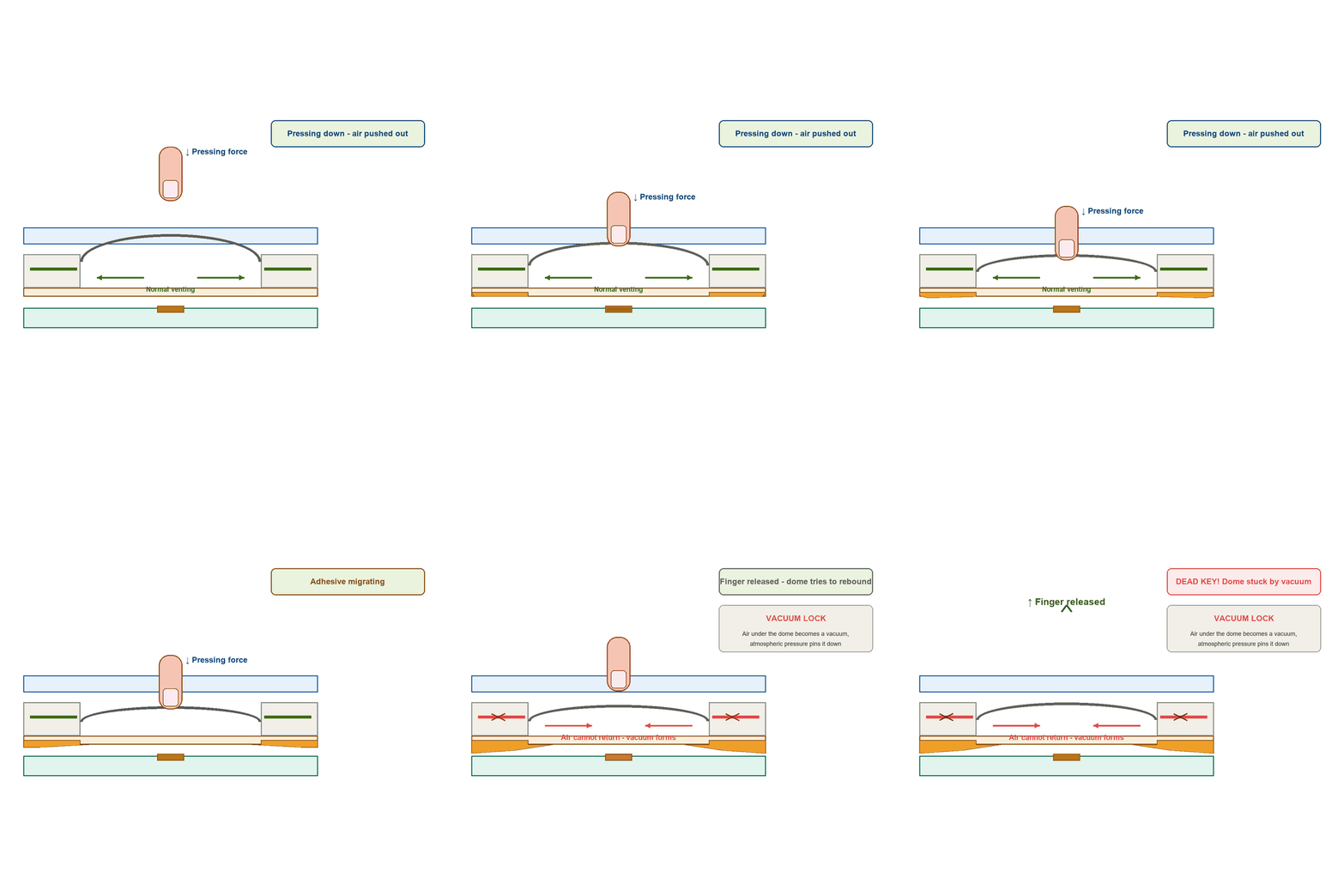
Adhesive bleed-out: The Dome Holder in the defective samples was a PET film coated on one side with pressure-sensitive adhesive (PSA). Over time—and accelerated by heat during assembly, storage, or operation—the adhesive migrated laterally beyond its intended boundary and contacted the FPC surface.
Adhesion to FPC traces: Once the adhesive contacted the FPC coverlay or exposed copper/gold contacts, the Dome Holder and FPC bonded together. This effectively bridged the gap between the retaining layer and the circuit layer, partially or completely eliminating the air space that the Dome Spacer was designed to maintain.
Vent-channel blockage: The Dome Spacer contains precision die-cut vent channels, usually narrow slots or cross-shaped passages, which release air during pressing and admit air during return. When the adhesive bonded the Dome Holder to the FPC, these channels became blocked or severely narrowed.
Negative-pressure lock: During pressing, the dome collapses and pushes the air inside the cavity out through the vent channel. If the channel is blocked by adhesive, air cannot flow back quickly when the user releases the key. A local vacuum forms beneath the dome. Atmospheric pressure above the dome and the vacuum below it create a net downward force that exceeds the dome's elastic recovery force.
Dead-key formation: The metal dome remains collapsed, the key cannot return, and the switch stays closed until the negative pressure dissipates naturally. This may take seconds or minutes; in severe cases, external intervention may be required.
3.2 Inherent risks of adhesive Dome Holders
The essence of this problem is not necessarily a manufacturing defect; it is a design risk embedded in the material selection. For custom membrane switch projects, material selection is especially important in precision-printing engineering:
PSA cold flow: Most pressure-sensitive adhesives creep under sustained pressure and/or elevated temperature, eventually flowing beyond the original die-cut boundary.
Assembly pressure: Pressure applied during lamination can squeeze adhesive into the Spacer cavity.
Thermal cycling: Repeated expansion and contraction caused by temperature changes accelerates adhesive migration and bond degradation.
Chemical interaction: Some PSA formulations may react with FPC coverlay materials or surface contaminants, creating unexpectedly strong adhesion.
3.3 Physics of the negative-pressure effect
The negative-pressure effect can be analyzed quantitatively. A typical cavity beneath a metal dome has a volume of approximately 2–5 mm³. During pressing, air exits through a vent channel approximately 0.3–0.5 mm wide and 0.1–0.15 mm deep. If this channel is partially or completely blocked, the return airflow rate drops sharply. According to Poiseuille's law, flow rate is proportional to the fourth power of the channel radius. Reducing the channel cross-sectional area by 50% can reduce airflow by more than 90%.
The pressure difference required to overcome a typical dome recovery force of 20–50 gf is only about 10–20 kPa over a 5 mm² dome area. This means that even a weak vacuum—very easy to create when the vent channel is blocked—can defeat the dome's return force.
4. Solution: Switch to an Adhesive-Free Dome Holder
As a custom membrane switch manufacturer with many years of precision-printing experience, KeyPadOne understands that the engineering fix is conceptually simple but requires strict control of material selection and processing. This is precisely where precision-printing expertise matters: replace the adhesive-backed Dome Holder with an adhesive-free Dome Holder film.
4.1 How to implement an adhesive-free Dome Holder
An adhesive-free Dome Holder is made from pure PET film, or it may have a very small, precisely located adhesive ring in the perimeter area away from the dome cavities. The domes can be retained in one of the following ways:
Perimeter-only bonding: Adhesive is applied only to the outer frame of the Dome Holder, at least 2–3 mm away from any dome cavity or vent channel. This fundamentally prevents adhesive from entering the dome-cavity area.
Mechanical retention: In some designs, the Dome Holder is completely adhesive-free and the stack is held together by lamination pressure and the adhesive on the overlay.
Localized dot bonding: Small, precisely positioned adhesive dots are placed only on the outer support legs of the dome, without touching the dome itself or the vent channel. This secures the holder without blocking the air path.
4.2 Recommended design rules for an adhesive-free Dome Holder
When switching the BOM to an adhesive-free Dome Holder, we recommend the following design rules:
• Define an adhesive-free zone of at least 2 mm around every dome cavity. No adhesive may be present within this zone.
• Ensure that the minimum cross-sectional area of each vent channel is no less than 0.05 mm², and keep it at least 1 mm outside any adhesive boundary.
• If perimeter bonding is used, specify the exact dimensions of the adhesive-free area on the mechanical drawing with GD&T.
• Consider a two-layer solution: one adhesive-free Dome Holder film plus a separate perimeter-bonding spacer ring, physically decoupling the retaining function from the venting function.
• Validate the design through dome-return testing: press each dome 100,000 times at room temperature (23°C) and at elevated temperature (60°C), confirming that 100% return within 50 ms.
5. Why This Matters to Purchasing and Quality Teams
For purchasing teams sourcing custom membrane switches, choosing a supplier with strong precision-printing capabilities is critical. If you are a purchasing manager or quality engineer evaluating membrane switch suppliers, the Dome Holder specification is one of the most important—and most easily overlooked—details in the BOM.
5.1 The real cost of a dead key in the field
A 0.5% dead-key rate at IQC may sound insignificant, but consider the actual mathematics: for a 20-key control panel, the probability that at least one key is already dead at shipment is (1 − 0.995²⁰) ≈ 9.5%.
The cost of a return in the end market is typically 5–10 times the cost of factory rework. A single field failure on a medical device or industrial controller can trigger a recall investigation, regulatory reporting, and permanent damage to the supplier relationship.
The incremental cost of switching to an adhesive-free Dome Holder is usually less than 2–3% of the unit price—far below the quality-assurance cost of one field failure.
5.2 Key questions to ask a membrane switch supplier
During supplier qualification, ask the following questions:
• Does your Dome Holder have adhesive? If so, how do you prevent adhesive migration into the dome cavities?
• What is the design of your Dome Spacer vent channels? Can you provide a cross-sectional drawing showing the airflow path?
• What is your dome-return testing plan? Does it include testing at elevated temperature?
• Can you provide a third-party reliability report—for example, 1 million cycles at 60°C / 90% RH—with return-time data?
6. Case Study: From a 3.2% Dead-Key Rate to Zero Defects
The OEM partner mentioned at the beginning of this article provided a compelling real-world example:
Initial condition: A 12-key industrial temperature-control panel supplied by an alternative vendor using an adhesive Dome Holder had a dead-key rate of 3.2%.
Failure analysis: Disassembly of 50 failed units confirmed adhesive migration in 47 dome cavities; in 41 cases, the vent channels were visibly blocked.
Corrective action: The Dome Holder was redesigned as an adhesive-free PET film. PSA was applied only around the outer frame, leaving a 2.5 mm adhesive-free zone around every dome cavity.
Result: The dead-key rate was 0% across the next three batches totaling 15,000 units. After eight months in the field, there were no returns.
The redesign cost approximately $0.03 per unit. The recovery cost for the first batch alone—including rework, scrap, replacement air freight, and customer penalties—exceeded $28,000.
7. Conclusion: A Three-Cent Decision That Protects Your Brand
The membrane switch industry has used adhesive-backed Dome Holders for years because they are convenient for high-speed mass assembly. However, physics is unambiguous: any adhesive layer near a dome cavity is a potential failure risk. The question is not whether the adhesive will migrate, but when—and under what temperature and pressure conditions—it will reach the vent channel.
Switching to an adhesive-free Dome Holder is not a cost; it is insurance. At only 2–3 cents per unit, it can eliminate:
• Dead-key field failures that are difficult to detect through IQC sampling.
• Negative-pressure locking that worsens over the product life cycle.
• Warranty claims, rework costs, and brand damage caused by unreliable HMI components.
If you are selecting or purchasing membrane switches, check your Dome Holder specification today. Our engineering team is ready to review your existing BOM, conduct a failure-risk assessment, and recommend a customized adhesive-free Dome Holder solution for your application.
Contact KeyPadOne (Dongguan Zhongjia Printing Co., Ltd.) for a complimentary Dome Holder design review and failure-risk assessment. As an experienced specialist in custom membrane switches and precision printing, we are ready to support you.
Case grouping
Are you looking for a reliable manufacturer?
We can quickly provide customers with market analysis, technical support and customized services.Contact Person

- Full Name:
- Tina Chen
- Tel:
+86 18165688198
- Email:
- tina.chen@keypadone.com
- WhatsApp:
- 8618165688198
- Address:
- No. 1 Shunxing Street, Liangjia Village, Shijie Town, Dongguan City, Guangdong Province