Custom Electronic Nameplates: Aluminum vs Polycarbonate vs PET Compared for Industrial Equipment
On industrial equipment, the nameplate is a compliance component, not a decoration. It carries the manufacturer identity, model and serial number, electrical ratings and safety markings that inspectors, service technicians and aftermarket buyers rely on for the whole life of the machine. In North American machine building, NFPA 79 and NEC Article 670 drive what data a machinery nameplate must show, and the plate is expected to stay legible and attached for the service life of the equipment.
Yet nameplates are one of the most commonly under-specified purchased parts. The recurring field failures are predictable: an adhesive layer that creeps and lifts at the edges on a powder-coated enclosure, a printed serial number that fades after a season of outdoor UV, a barcode that no longer scans after washdown chemicals, or a plate specified by material name alone ("just polycarbonate") with no film grade, hardcoat, ink system or adhesive defined. This guide walks through the decisions an OEM engineer or buyer actually needs to make, in the order they affect the outcome: which type of plate the application needs, which substrate fits, how the marking is built into the surface, why the adhesive fails first, and what information a manufacturer needs to quote accurately.
Which Type of Nameplate Are You Actually Buying?
"Nameplate" covers several parts with very different priorities. Sorting the requirement into one of these five types early prevents the most common quotation mismatches:
- Rating and identification plates. Model, serial number, electrical ratings, manufacturer data on machinery, pumps, enclosures and control cabinets. Legibility for years drives every choice: metal substrate, subsurface or etched marking, mechanical or high-performance adhesive attachment.
- Safety and warning plates. Positioned at heat surfaces, moving parts, electrical enclosures and pinch points. In US workplaces, OSHA 29 CFR 1910.145 governs accident-prevention signs and tags, so signal words, symbols and viewing distance belong in the specification, not as an afterthought.
- Serialized and asset labels. Variable data at scale - sequential numbers, date codes, Data Matrix or Code 128 symbols - for warranty, recall and fleet management. Data permanence pushes toward etched, laser-marked or sealed-print constructions rather than surface printing alone.
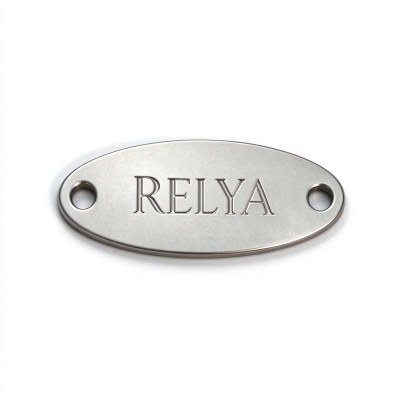
- Brand badges and decorative plates. Brushed aluminium badges, embossed logos, diamond-cut borders and dome finishes on appliances and consumer equipment. Appearance leads, but the badge still has to survive handling, cleaning and transport.
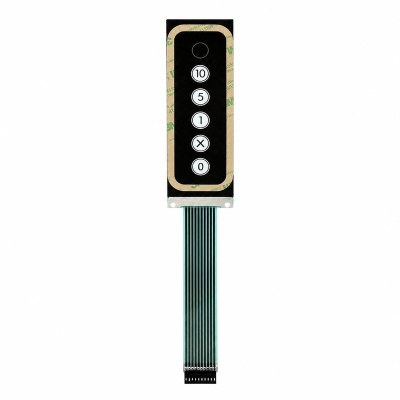
- Control-panel plates and graphic overlays. Printed panels that label buttons, switches and displays. On high-use interfaces, graphics belong behind the surface - reverse-printed on the back of a transparent window layer - so wear never touches the ink.
The same four data jobs repeat across all five types - identification, compliance, traceability and brand - but the construction that satisfies one type can fail another. A decorative badge construction will not survive a washdown; a washdown rating plate is over-engineering for a badge. Specify the plate as a system, not as a material.
The Four Substrate Families, Compared
Four substrates cover the large majority of industrial electronic nameplates: anodized aluminium, stainless steel, polycarbonate (PC) and polyester (PET). The table below lists typical published ranges; always confirm against the actual film or alloy datasheet, because grades differ widely.
| Property | Anodized aluminium | Stainless steel 304/316 | Polycarbonate (PC) | Polyester (PET) |
|---|---|---|---|---|
| Typical thickness | 0.3 - 1.5 mm | 0.3 - 1.0 mm | 0.125 - 1.0 mm | 0.05 - 0.35 mm |
| Max continuous service temp (typical) | 200°C and above | 300°C and above | about 135°C | about 100 - 105°C |
| Outdoor UV | Excellent (print sealed under anodic layer) | Excellent | Good with UV-stable grade or hardcoat | Good with stabilized grades |
| Chemical resistance | Good (sealed) | Excellent | Fair; attacked by aromatic solvents and strong alkali | Excellent |
| Abrasion resistance | Excellent | Excellent | Good with hardcoat | Good with overlaminate |
| Forming and embossing | Yes, within alloy limits | Limited | Yes, cold embossing | Yes, light embossing |
| Relative cost at volume | Medium - high | High | Medium | Low |
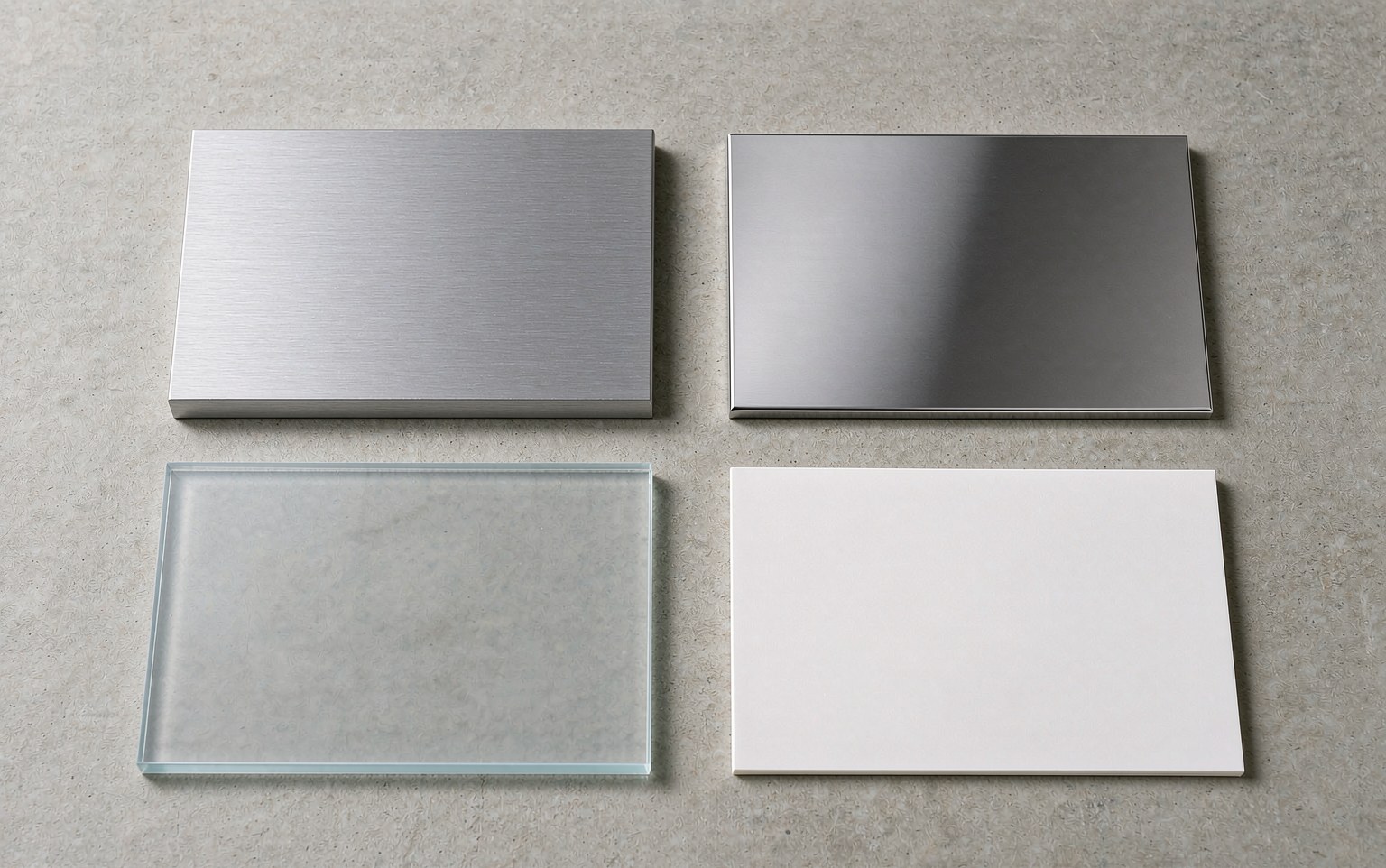
The four substrate families as physical samples: brushed aluminium, polished stainless steel, translucent polycarbonate and matte polyester film. Surface texture and thickness differences are visible before any printing is applied.
A practical warning from the production floor: a material name is not a specification. Two "polycarbonate nameplates" can behave completely differently if one uses a general-purpose film with a solvent ink and the other uses a UV-stabilized film with sub-surface printing and a hardcoat. For plastic films, ask the supplier to state the film grade class and its UL 94 flammability rating where relevant, thickness tolerance, ink system, hardcoat or overlaminate type, adhesive family, and the test method behind any durability claim (for example ASTM D3359 cross-hatch for print adhesion, ASTM B117 or ISO 9227 for salt spray, ISO 4892 for UV exposure). Catalogue adjectives do not survive a washdown; test data does.
How the Marking Is Built: Finishes and Printing Processes
The substrate is only the carrier. Legibility over the product's life comes from how the image is put into or onto the surface:
- Anodizing. Type II decorative anodic layers are commonly specified around 5 - 25 μm, Type III hardcoat around 25 - 75 μm. Printing sealed beneath the anodic layer is the classic approach for outdoor-rated aluminium nameplates, because the image is protected by the oxide itself rather than by an ink film.
- Chemical etching. Etched and filled marks sit below the surface, which suits stainless rating plates exposed to abrasion, chemicals or high temperature.
- Screen printing. Still the workhorse for volume metal and plastic plates: thick, opaque ink films, spot colours matched to brand standards, and economical tooling for repeat orders. The quality variables that matter are ink-film opacity (so a serial number stays readable on a dark background), registration accuracy between colour layers, and cure - under-cured ink passes the factory bench and fails the first solvent wipe in the field.
- Sub-surface (reverse) printing. On transparent films, graphics are printed on the back side and viewed through the material, so the substrate itself protects the ink. This is the standard construction for control-panel overlays and windowed plates, and the reason a panel can survive a million fingertip touches without the legend wearing off.
- Digital printing. Economical for short runs, gradients and prototypes that must visually match the eventual screen-printed production part.
- Laser marking and annealing. Permanent, non-contact marking on stainless and aluminium; the natural process for serialized variable data, since each plate gets a unique mark without tooling changes.
- Diamond cutting and embossing. Diamond-cut bright borders and embossed logos are common on appliance and audio branding plates where the light play across facets is part of the design.
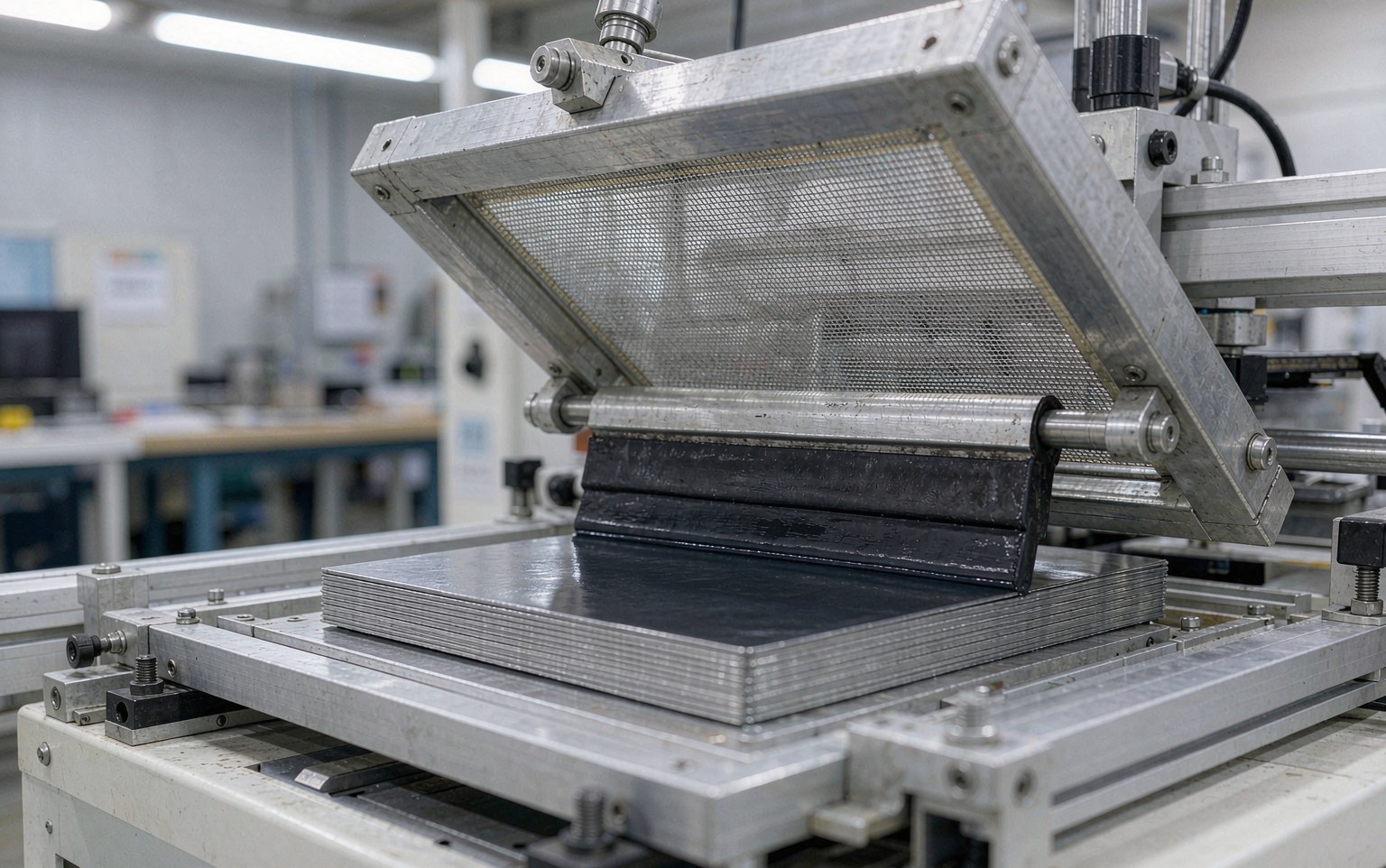
Precision screen printing on stacked aluminium blanks. Ink-film thickness, registration and cure windows - not the substrate - decide how the marking survives its environment.
For serialized or variable data, confirm the printing and verification chain early. A Code 128 or Data Matrix symbol is only useful if it scans at the end of its life; symbol quality is graded under ISO/IEC 15415 (2D) and ISO/IEC 15416 (1D), and the layout must reserve a clean quiet zone around the symbol. A supplier with in-house CCD verification can prove grade levels rather than estimate them.
The Adhesive Layer: Where Most Field Failures Start
When a nameplate fails in the field, the substrate rarely fails. The adhesive interface does. The mechanics are unglamorous but predictable: the adhesive must wet out the equipment surface, build to full strength, and then hold the plate against peel, shear, temperature cycling and chemical attack for years.
The practical selection points:
- Surface energy. Adhesives wet out surfaces above roughly 38 - 42 dyn/cm reliably. Powder coat, most polypropylene and polyethylene, and textured plastics are low-energy surfaces and need an adhesive grade designed for them, or a primer, or a mechanical fastening method instead.
- Tape family. Thin acrylic transfer tapes (the 200MP class, e.g. 3M 467MP/468MP equivalents) suit smooth, flat, high-surface-energy substrates. Acrylic foam tapes of the VHB class add gap-filling and stress relaxation for uneven or curved surfaces.
- Application conditions. Most acrylic tapes want the surface, the tape and the room around 15 - 35°C at lamination. Bond strength at room temperature is typically reached after 24 hours and continues to build for 48 - 72 hours; a plate adhesive-tested immediately after application will under-read.
- Test method, not adjectives. Peel values should be quoted per ASTM D3330 on your actual substrate, not on the tape maker's test steel.
- Geometry. Sharp corners concentrate peel stress. Radiused corners, an internal corner relief, or a slightly smaller plate on a heavily curved surface measurably extend service life.
- Surface preparation. A clean, dry, IPA-wiped surface is the cheapest reliability improvement available; mould-release agents and silicone residues are the most common hidden killers.
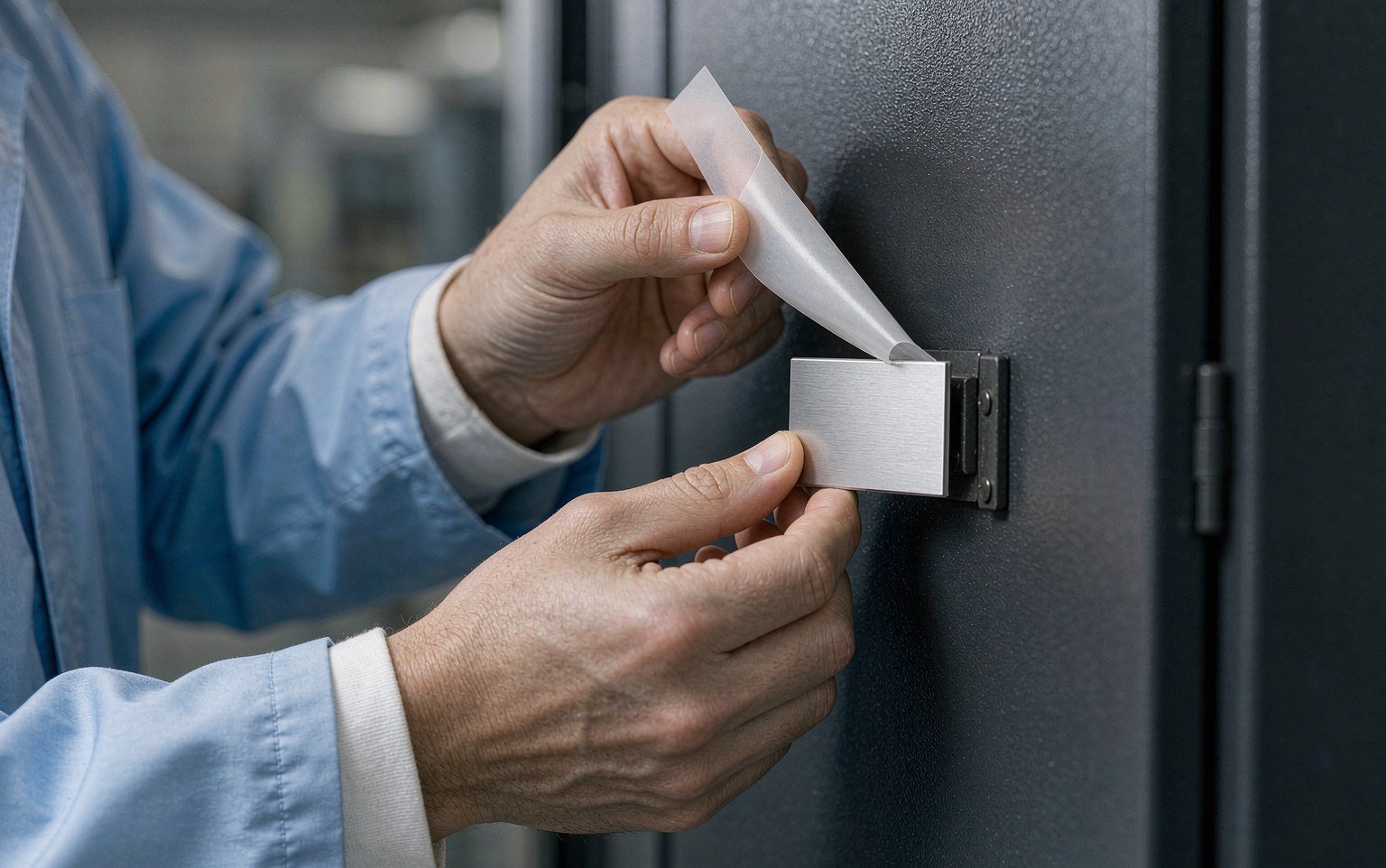
Laminating an adhesive-backed plate onto a powder-coated enclosure. Low-surface-energy powder coat is exactly where edge lift starts when the adhesive grade is chosen by price alone.
When the environment defeats adhesive - sustained temperatures beyond the tape rating, chemical splash, or food-grade washdown - the plate moves to mechanical mounting. Rivets and screws are the traditional answer on heavy equipment, and hybrid constructions (adhesive plus mechanical) are common where both flatness and vibration are concerns.
Matching the Construction to the Environment
Rather than asking "which material is best", ask "which construction stays readable and attached in this environment". Typical pairings:
| Environment | Typical construction direction | Verify with |
|---|---|---|
| Indoor office / commercial electronics | PET or PC film, sub-surface print, transfer tape | ASTM D3359 cross-hatch, abrasion rub |
| Outdoor, unsheltered equipment | Anodized aluminium with sealed print, or UV-stabilized PET with overlaminate | ISO 4892 / ASTM G154 UV exposure, thermal cycling |
| Washdown, food and medical surfaces | Stainless with etched or laser-annealed marks; chemical-resistant PET | Chemical splash testing, ISO 9227 salt spray |
| Engine bays, oil mist, high heat | Aluminium or stainless, mechanical or high-temp adhesive attachment | Thermal cycling, oil immersion |
| Curved or textured enclosures | Thin PC/PET with conformable foam adhesive, radiused corners | Peel per ASTM D3330 on the real substrate |
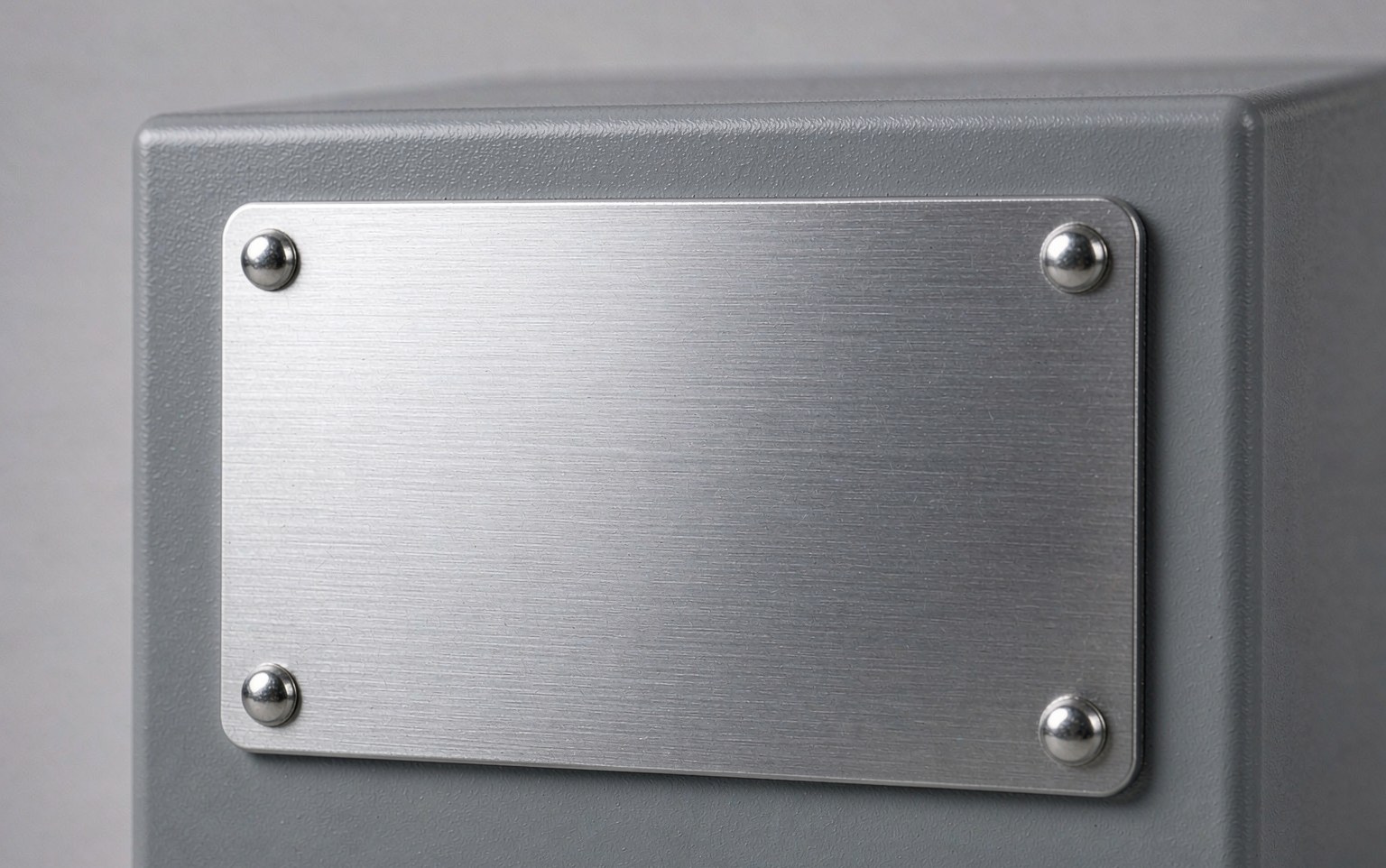
A mechanically fastened plate on painted machine housing. Riveted attachment removes adhesive selection from the risk equation entirely - the standard answer for high-vibration, outdoor and heavy equipment.
Specify the Failure Mode, Not Just the Material
The most useful sentence a buyer can put in a nameplate specification describes what must never happen in service - not "we need a durable nameplate", but concrete failure modes:
- "The barcode must still scan after six months of daily IPA wiping."
- "The warning text must stay readable after two years outdoors, unsheltered."
- "The plate must not lift at the edges on this textured powder coat."
- "The serial number must remain visible after contact with cutting oil."
- "The badge must not scratch during normal handling and shipping."
Framing the requirement this way does two things. It forces the internal team to agree on what the plate really has to survive - environment, cleaning agents, handling - before anyone talks about materials. And it gives the manufacturer something actionable: a competent supplier can map each failure mode to a construction and a test method, and will tell you honestly when a cheaper construction cannot meet one of the listed modes.
Legibility, Serialization and Compliance
Three compliance topics come up repeatedly on OEM programs:
- UL 969 marking and labeling systems. Acceptance is evaluated on the complete construction - film or metal, ink, overlaminate and adhesive together - on the intended surface. A substrate that is "UL listed" in isolation does not make the finished nameplate compliant. Ask which exact construction the supplier's UL file covers.
- MIL-STD-130 and UID. Programs supplying the US Department of Defense need marking to meet MIL-STD-130 requirements, including symbol grade and contrast, which pushes the design toward etched or anodized constructions with verified Data Matrix quality.
- Environmental compliance. RoHS and REACH declarations should cover the inks, adhesives and surface treatments, not only the substrate. Suppliers with RoHS/halogen screening equipment in-house can support declarations with measurements rather than paper alone.
On legibility, the working rule is contrast first, size second: a dark mark on a light field (or the reverse), a character height chosen for the reading distance of the installation, and a symbol grade of C or better after environmental exposure, not just on day one.
What Drives Cost and Lead Time
- Substrate type and thickness, and whether the surface treatment (anodizing, hardcoat) happens in-house or is outsourced.
- Number of print colours and colour-matching effort; spot-colour brand standards cost more than black-on-metal.
- Tooling: a custom die for high volumes versus digital or laser cutting for prototypes and short runs.
- Variable data: serialized numbers, Data Matrix printing and verification steps each add process stages.
- Testing and documentation: UL file coverage, first-article reports, material certifications and retained samples.
- Order quantity and repeat cadence; forecast stability supports material pricing stability.
From RFQ to First Article: What a Good Supplier Runs Like
Nameplate quotations fail when the RFQ is a photo and a quantity. A quote you can hold the supplier to includes:
- 1:1 dimensioned drawing (PDF or vector) with hole positions, corner radii and tolerances.
- Substrate and thickness, or the environment the plate must survive so the manufacturer can propose one.
- Finish and colour references (Pantone or physical sample), including gloss level.
- Serial or barcode rules: symbology, data format, verification grade required.
- Mounting method and the actual equipment surface material and finish.
- Exposure summary: indoor/outdoor, temperature range, chemicals, cleaning agents, UV.
- Compliance requirements: UL 969 file coverage, RoHS/REACH declarations, country of origin.
- Target annual volume and first-order quantity.
From there, a disciplined workflow looks the same at every capable plant: application details and artwork go in; material, marking method, finish and mounting are confirmed together; a digital proof fixes layout and content; a physical sample proves material, thickness, edge quality, colour and adhesive on the real surface; then production releases against the approved sample, and the first delivery batch is inspected against it. Two checkpoints deserve insistence. First, approve the sample on your mounting surface - a label that bonds beautifully to the supplier's test steel can tent on textured powder coat. Second, approve colour on the process that will run at volume, because digital and screen renditions of the same Pantone reference can differ slightly.
When you compare manufacturers, the useful questions are process questions, not brochure questions: Which constructions does your UL file actually cover, and will you re-test on my surface? Can you provide peel, cross-hatch and thermal-cycling data from your own laboratory on the exact construction quoted? How is variable data controlled and verified, and can you show CCD inspection records for a serialized lot? What is your change-control procedure when the film, ink or adhesive lot changes? Which steps - printing, coating, die-cutting, assembly - happen inside your own plant?
KeypadOne is the brand of Dongguan Zhongjia Printing Co., Ltd., a precision printing manufacturer founded in 2009. The 20,000 m² facility runs cleanroom screen-printing lines, high-speed rotary presses, HP digital presses, die-cutters and automatic punching under ERP + MES batch traceability, with nameplate and panel capacity of roughly 10 million pieces per month. The quality system includes ISO 9001:2015, IATF 16949:2016 and QC 080000:2017, with RoHS, REACH, SGS and UL documentation on selected constructions; the in-house laboratory covers CCD vision inspection with barcode verification, peel and tack testing, thermal-cycling chambers and RoHS/halogen analysis. Engineering support spans adhesive customisation, structural design and tooling from first article to mass production. You can review the quality and certification overview or send a drawing through the inquiry page for a construction proposal and quotation.
Key Takeaways
- Sort the requirement into a type first - rating plate, safety plate, asset label, badge or overlay - because each type has a different definition of "good enough".
- Specify the nameplate as a system: substrate, ink system, protective layer, adhesive and mounting are decided together, and they fail together.
- A material name is not a spec. Film grade, hardcoat, ink system, adhesive family and test methods belong on the drawing.
- Write the failure modes into the specification; they are the fastest way to separate suppliers who test from suppliers who estimate.
- Most field failures start at the adhesive interface: surface energy, application temperature, dwell time and corner geometry decide the outcome.
- UL 969 acceptance applies to the complete construction on your surface, so ask for the file scope before assuming compliance.
- If you have a drawing or an existing sample, the manufacturers you shortlist should be able to return a construction proposal with test data - and that response quality is itself a supplier assessment. KeypadOne supports industrial control components and membrane switch programs alongside nameplates, which simplifies interface sourcing when the plate and the switch share a panel.
FAQ
Which nameplate material lasts longest outdoors?
Aluminium with printing sealed under the anodic layer, and stainless steel with etched or laser-annealed marks, are the reference constructions for long outdoor service. UV-stabilized PET with an overlaminate can also reach multi-year outdoor life at lower cost. Whichever route you take, base the decision on UV exposure testing per ISO 4892 or ASTM G154 on the finished construction rather than on catalogue descriptions.
Can one construction carry a UL 969 marking?
UL 969 recognises a marking and labeling system: the specific film or metal, ink, overlaminate, adhesive and surface, tested together. Ask the supplier for the UL file number and the exact constructions covered, and whether your intended mounting surface is inside that scope. If it is not, a limited-scope evaluation on your substrate is usually the correct path.
Why did the nameplate lift at the edges after a few months?
Edge lift usually traces back to one of four causes: a low-surface-energy substrate that the adhesive never wet out, application below the recommended temperature range, insufficient dwell time before the equipment entered service, or sharp plate corners concentrating peel stress. Reviewing those four items against the adhesive technical data sheet normally identifies the fix - a different tape family, a primer, warmer application, or radiused corners.
Can nameplates be customised in shape, colour and finish?
Yes. Size, contour, corner radii, cutouts, thickness, colour, gloss and mounting configuration are all specified per project: brushed or textured metal surfaces, embossed logos, diamond-cut borders, dome resin finishes and die-cut contours are routine. The two constraints to respect are minimum corner radii for the die and the forming limits of the substrate - deep embossing on thin PET, for example, will distort printed graphics, so the artwork should be engineered around the process, not against it.
What artwork and data should I prepare for a quotation?
A 1:1 vector drawing with dimensions and tolerances, colour references, the serial or barcode rules including symbology and data format, mounting hole positions, and a description of the mounting surface. If you have an existing nameplate you want matched, shipping the physical part accelerates everything: thickness, adhesive and finish can be measured and a first article produced for comparison.